This project involved the stacking and permanent structural welding of shipping containers to form a continuous protection wall at Levy’s site. While shipping containers are often thought of as temporary storage or modular space solutions, this scope required a very different approach—one focused on precision, structural integrity, and long-term durability in an active industrial environment.
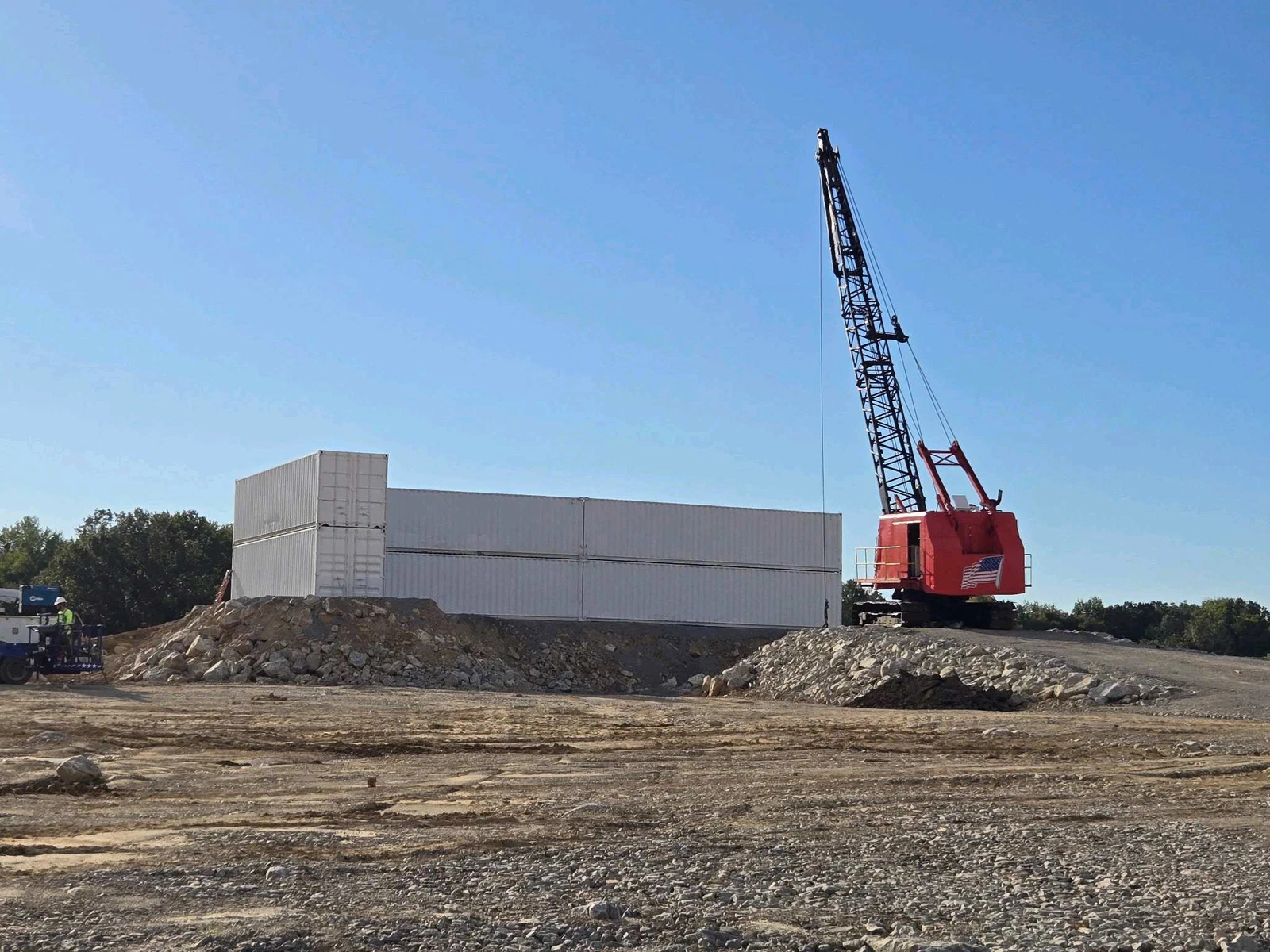
Xtreme Services was contracted to provide all labor, equipment, and materials required to stack and weld together nine 40-foot shipping containers into a single, rigid structure. The final configuration consisted of three containers long and three containers tall, welded together with both vertical and horizontal fish plates to function as one unified protection wall.
This was not a placement-only job. It required careful planning, crane coordination, strict tolerance requirements, and field welding at height to ensure the finished structure performed as intended.
Scope Overview and Project Responsibilities
The scope of work included:
- Crane services to set and stack nine 40-foot shipping containers
- Manlift access for welding at elevated connection points
- A fully equipped tool truck with dual welders on site
- Structural welding of containers using vertical and horizontal fish plates
- Alignment and verification of container placement across the full run
Levy was responsible for providing:
- The shipping containers
- A level, compacted pad measuring 140 feet by 12 feet
- Placement of the containers within reach of the crane prior to the set
- Clear, uninterrupted access to the work area during installation
The pad was required to be within 1 inch of level over the entire 140-foot run, a tolerance that is critical when stacking containers three units high. Even minor deviations can compound vertically, creating alignment issues, stress concentrations, or challenges during welding.
Site Preparation and Pad Requirements
Before any containers could be set, pad conditions were reviewed to confirm compliance with the project requirements. Because the finished wall would rely on the pad for uniform load distribution, proper compaction and levelness were essential.
A protection wall of this size behaves very differently than individual containers placed independently. Once welded together, the structure acts as a single mass, meaning any inconsistencies at the base can transfer load unevenly throughout the system.
The pad’s tight tolerance allowed the containers to be stacked cleanly without forcing alignment during crane placement—reducing risk and improving overall weld quality.
Crane Set and Container Placement
Container placement was performed using a crane, staged to allow efficient stacking without unnecessary repositioning. Each container was set with deliberate attention to orientation, elevation, and alignment to ensure proper fit-up at all connection points.
The stacking sequence was carefully controlled:
- Bottom containers were placed and verified first
- Second-level containers were set directly over their lower counterparts
- Final top-level containers were positioned once alignment checks were confirmed
Maintaining alignment across all three levels was critical, as even small offsets could interfere with fish plate installation or introduce unwanted stress into the welded joints.
Clear communication between the crane operator and ground crew was essential throughout the process. Every lift was planned and executed to minimize handling time while maintaining full control of each container during placement.
Welding Methodology and Structural Integration
Once the containers were stacked and verified, welding operations began. The goal was to transform nine individual containers into one solid, unified structure.
This was accomplished using:
- Vertical fish plates to tie containers together from bottom to top
- Horizontal fish plates to connect containers across the full length of the wall
These plates were welded at each container interface, creating continuous load paths throughout the structure. By tying the containers together in both directions, the finished wall behaves as a single unit rather than a collection of stacked elements.
Manlifts were used to safely access elevated weld points, allowing welders to maintain proper positioning and technique at all heights. Weld quality and consistency were prioritized, as these joints are critical to the long-term performance of the wall.

Equipment and Crew Coordination
This project required tight coordination between multiple pieces of equipment and crews working simultaneously:
- Crane operations for container placement
- Manlift access for welding crews
- Tool truck staging to support continuous welding operations
Because the scope assumed no production interruptions, maintaining workflow efficiency was key. Equipment was positioned to avoid conflicts, and work sequencing was planned to keep welders productive while minimizing downtime.
Having the right equipment on site—and staged correctly—allowed the team to move seamlessly from placement to welding without delays.
Safety and Access Considerations
Working with stacked containers and heavy lifting operations introduces inherent risks, especially when welding at height. Safety protocols were followed throughout the project to protect both personnel and equipment.
Key considerations included:
- Controlled crane lifts with clear exclusion zones
- Proper fall protection and lift operation procedures
- Organized access routes to keep the work area clear
- Continuous communication between crews during all phases
Clear working access to the site was essential, as specified in the scope. The ability to work without interruptions allowed tasks to be completed safely and efficiently, reducing exposure time and minimizing risk.
Final Outcome
The completed structure is a three-high, three-long welded shipping container protection wall, permanently tied together with structural fish plates to function as a single, rigid barrier.
Rather than relying on gravity or stacking alone, the welded connections ensure long-term stability and performance under site conditions. The finished wall provides durable protection while maintaining a clean, organized footprint aligned with the site’s operational needs.
This project highlights the importance of execution in structural container applications. While shipping containers themselves are standardized, turning them into a reliable, welded system requires experience in heavy lifting, alignment, and field welding under real-world conditions.
Built for Function, Installed with Precision
At Xtreme Services, projects like this are approached with the understanding that industrial solutions must perform first and foremost. Precision, coordination, and craftsmanship are what turn a simple concept into a dependable structure.
This protection wall was built not just to stand—but to last.